Showing posts with label John Collier. Show all posts

Introduction (Part 2)

0 comments

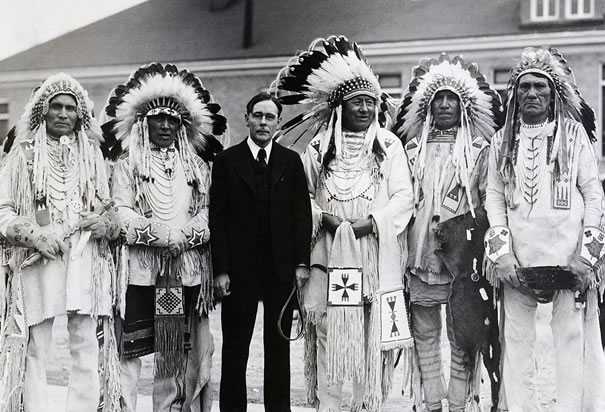
Commisioner of Indian Affairs John Collier
meets with South Dakota Blackfoot Indian chiefs in 1934
Edwin Embree was one of the few who discerned the basic validity of Collier's approach. His book Indians of the Americas, written in 1939, five years after the enactment of the Indian Reorganization Act, was one o the first attempts to place the new Indian policy in an intelligent light. Embree sought to span the myriad Indian tribes and cultures by discussing a few of the most spectacular and divergent tribes. In the United States proper he dwelt on the Iroquois, the Pueblos and the Oglala Sioux, while the big-three nations of the south, the Maya, Aztecs, and Incas, served to ilustrate the Indian nations of Central and South America.

In a real sense, Embree was guilty of romanticizing the tribes he covered. The days of buffalo-hunting, pyramid-building, and trade wars of the eastern wood-lands were only misty memories when Embree wrote; he might better have written of the contemporary cultures of those tribes during the Depression years. But his period was a time of startling revision of the meaning and importance of culture. In such a period of flux, perhaps no one could blame Embree for seeking to represent culture in its traditional state of purity. by adopting this approach he was able to show the life-styles of the respective tribes and how these had politely bowed to the modern world but yet remained fundamentally untouched.
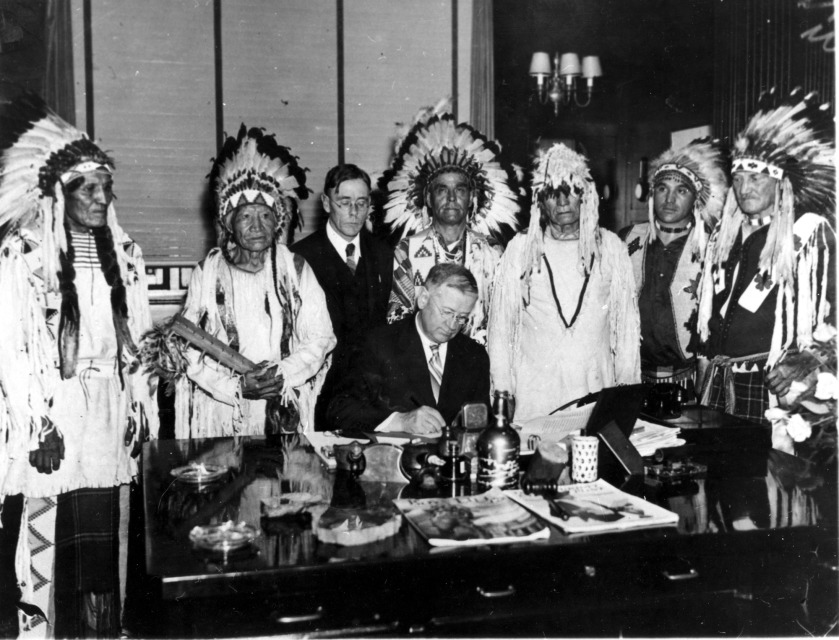
The Indian Orgamization Act of 1934

The important contribution of Embree's book was to assist in the defense of Indian tribal cultures and governments at a time when they sorely needed defense. The ensuing three decades have shown beyond doubt that the policies advocated by John Collier have been beneficial to Indian people. Today Indian tribes largely pay for their own governments out of tribal income developed under enterprises originally chartered under the Indian Reorganization Act provisions. The shrinking land base has been fairly well stabilized. With the social programs of the last decade initiated by such agencies as the Office of Economic Opportunity, the Area Redevelopment Administration (later renamed Economic Development Administration), and the Housing and Urban Development Department, Indian tribes have accomplished a great deal in bringing a decent standard of living to the people on the reservations.

Engraving of the American Indian town of Pomeiooc.
Embree's concluding chapter is somewhat dated, yet it retains a basic understanding o the nature of the cultural clash between the immigrant whites and the original inhabitants of this continent -a conflict that is yet to be resolved. Indians are no longer a scattered and broken people. Migrations to the urban areas during the Second World War and the Korean conflict created an urban population that is now larger than the reservation population. The Indian birth-rate has remained consistently high, so that the reservation population is now, in spite of constant departures of families, higher than at any time since the reservations were established.

Introduction (Part 1)

0 comments

North American Indian
So deeply had the philosophy of the melting pot been entrenched in the American psyche that by the early years of this century the field of Indian affairs was regarded as merely a matter of administration. In 1887 the massive tribal landholding were allotted in severalty to the members of the respective tribes under the theory that ownership of individual plots of land would serve to destroy the traditional Indian method of holding all lands in common. It was hoped that individual ownership would act as a device to server tribal relationships and render individual Indians free of tribal restraints and customs.

By 1929 the situation on the reservations was disastrous  Over ninety million acres of land had gone out of Indian ownership, and the once-prosperous tribesmen were reduced to desperate paupers holding a shrinking island of virtually worthless land. Studies by Congressional committees indicated that unless federal policy were radically reoriented, the reservations would become death-traps for those who remained  on them; at the same time, those who left, without training, totally incapable of supporting themselves, would form a tragic remnant huddled in the backwaters of urban areas.
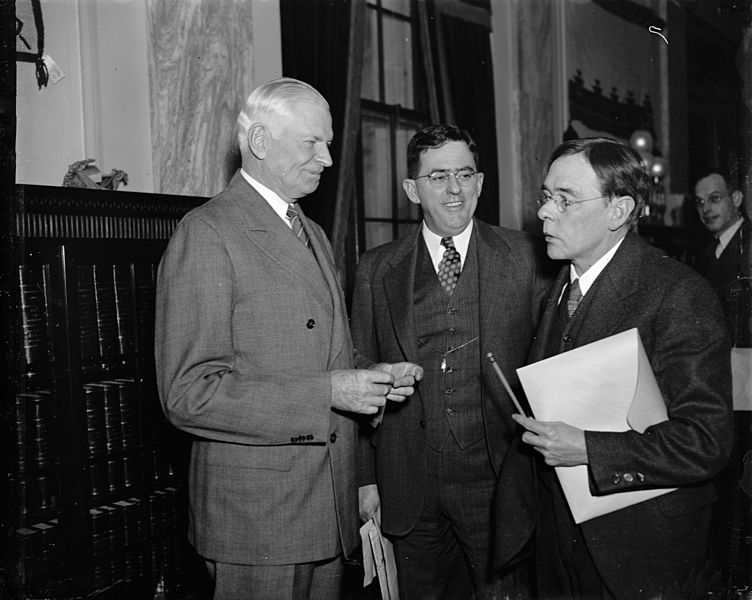
John Collier (right), Elmer Thomas (left), and Claude M. Hirst (center)

In 1934 John Collier, Frankin Roosevelt's Commissioner of Indian Affairs, introduced the Indian Reorganization Act, which was quickly written into law. The basic aim of the legislation was to support native culture and reverse the policy of forced assimilation of individual Indians. Under the new I.R.A. provisions, native religions which had been banned for nearly half a century were recognized as valid and proper. Economic-development corporations and land-consolidation programs were begun by reservation peoples to stop the erosion of the land base, develop a source of tribal income and provide employment fo the reservation residents.

The innovations of the Collier years were startling. For nearly three centuries white Americans had blithely accepted the premise that the American Indian was a vanishing race. His culture, while colourful and unusual to western Europeans, was thought to be forever crushed by the inroad of civilization. Most of the people who had been working in the field of Indian affairs saw the Collier years as a return to the primitive and savage state. Missionaries viewed his tolerance of native religions as the work of the Antichrist. Conservatives looked askance as tribal governments were set up which held the land in common ownership. To some it was the beginning of Communist intrusion into American political affairs.


American Indian tents